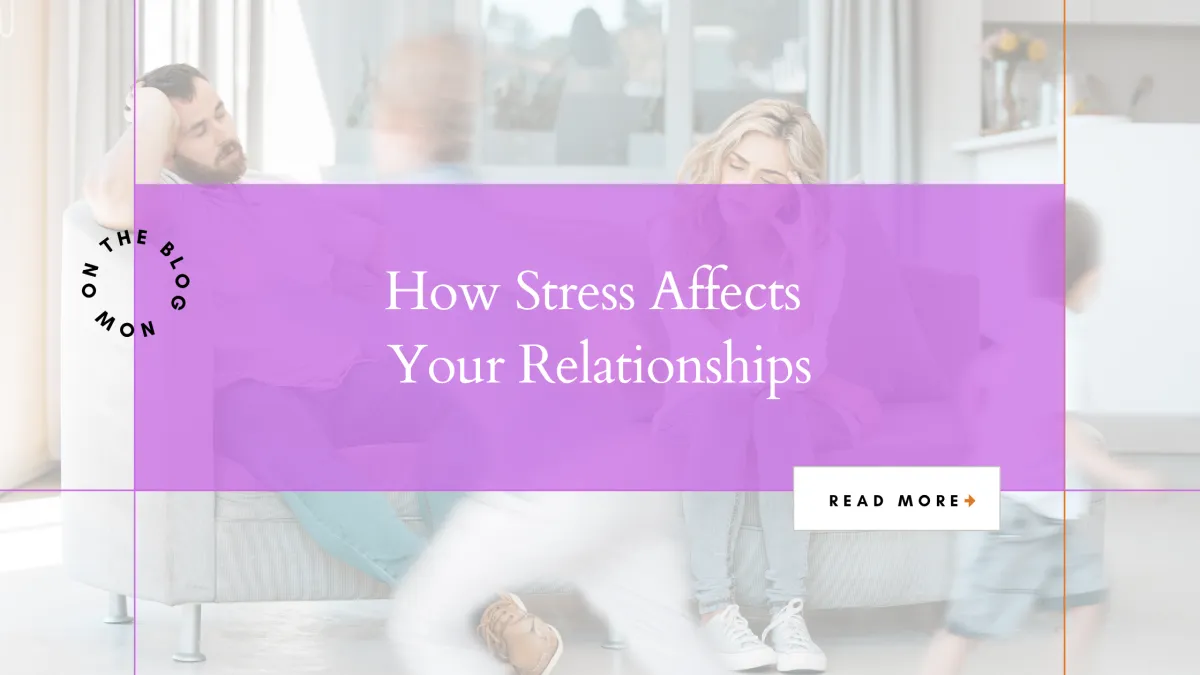
How Stress Affects Your Relationships
A husband forgets to text back.
A teenager answers with one word.
A partner leaves dishes in the sink.
On a calm day, these moments might barely register.
But on a stressful day?
They can feel surprisingly irritating, disappointing, or even hurtful.
Many people assume the problem is the other person.
But often, stress changes the way we interpret what is happening.
When your brain is under pressure, it becomes more focused on detecting problems, managing demands, and protecting your energy.
As a result, you may find yourself reacting more strongly, feeling less patient, or assuming negative intentions where none exist.
This doesn't mean you're becoming a difficult person.
It means your nervous system is carrying a heavier load than usual.
And once you understand that, you can stop blaming yourself or the people you love and start working with what your brain is actually experiencing.
Imagine feeling less reactive at home.
You pause before jumping to conclusions.
You respond instead of react.
Small frustrations stay small.
And your relationships feel lighter, warmer, and easier to enjoy.
Not because the people around you changed.
But because you had more mental and emotional space available for connection.
So what is stress doing behind the scenes?
When stress remains high, the brain naturally:
• Becomes more sensitive to potential problems
• Has less capacity for patience and empathy
• Interprets neutral situations more negatively
• Reacts faster and reflects later
This is why stress often creates tension in otherwise healthy relationships.
Not because something is wrong.
But because your brain is operating in protection mode.
The good news?
You can interrupt this pattern with a simple practice I call Mind CPR
C — Calm Down
Pause and take one slow breath.
P — Process
Notice what's happening inside you.
"I'm still thinking about work."
"I'm overwhelmed."
"I'm more stressed than I realized."
No need to fix it just notice.
R — Respond
Bring your attention back to the person in front of you.
Not perfectly.
Just a little more fully than before.
It's about giving yourself a small reset so you can return to the moment. 🌿
For example, imagine your partner forgets to reply to a message.
Your first thought might be:
"Why are they ignoring me?"
But after using Mind CPR, you realize you've had a stressful day and are feeling emotionally drained.
The situation hasn't changed.
But your reaction has.
And often, that's where healthier conversations begin.
Some days you'll remember this tool.
Other days you'll react before you pause.
That's normal.
You're not trying to be perfectly calm.
You're learning to notice when stress is taking the driver's seat and gently reclaiming control.
If this article resonated with you, there may be a deeper stress pattern operating beneath the surface.
The High Functioning Brain Under Pressure Index can help you understand how stress may be affecting your thinking, emotions, and relationships and identify the recovery strategies your brain needs most.
Because sometimes what looks like a relationship problem is actually a nervous system asking for support. 🤍
If someone in your circle is struggling and is based in Washington State (USA), please feel free to refer them to us. It’s an honor to support individuals on their healing journey. As a small thank you, we’d love to include you in our VIP community for helpful insights and exclusive updates.